
Table of Contents
- Full Drill vs Partial Drill Kits: What's the Core Difference?
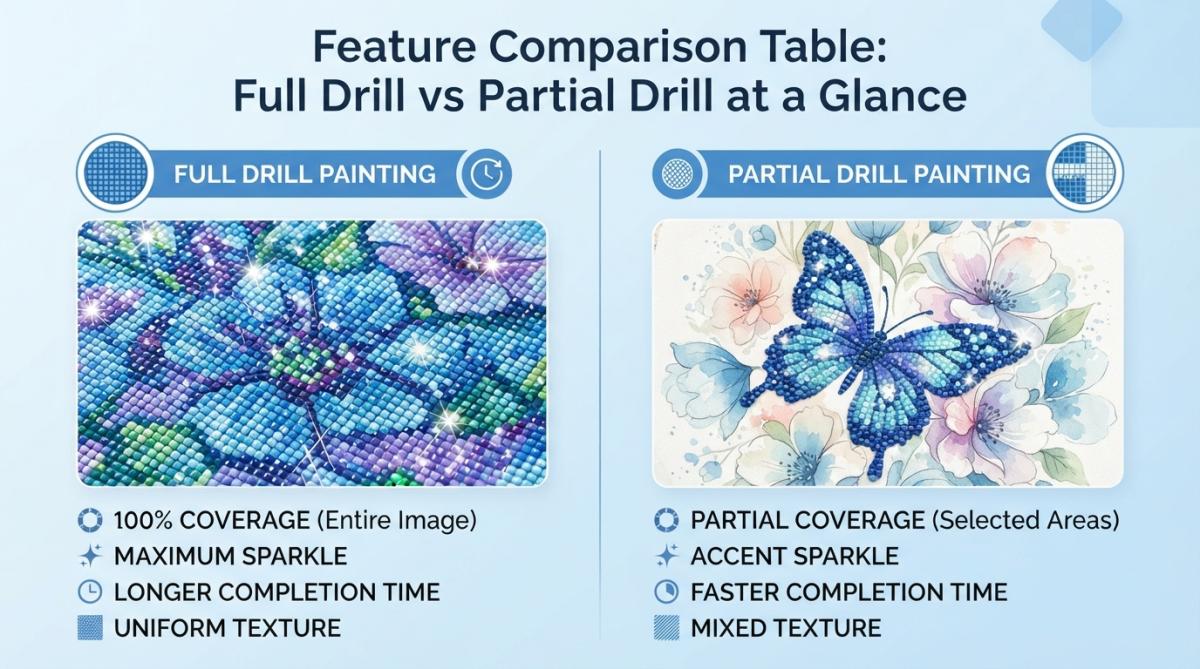
- Feature Comparison Table: Full Drill vs Partial Drill at a Glance
- Diamond Painting for Beginners: Which Should You Start With?
- Round vs Square Drills: How They Affect Your Choice
- Time Commitment and Difficulty: Full Drill vs Partial Drill
- Essential Diamond Painting Tips for Both Kit Types
- Finishing Your Work: Diamond Painting Sealing Methods Explained
- Pros and Cons: Full Drill Kits in Detail
Full Drill vs Partial Drill Kits: Complete 2026 Comparison
Last Updated: July 24, 2026
When shopping for a diamond painting kit, the choice between full drill vs partial drill shapes everything about your experience, from time investment to final visual impact. At Jeanne Argent Atelier, we've helped crafters navigate this decision for years. The answer isn't which is "better," but which matches your goals, patience level, and vision for the finished artwork.
Full Drill vs Partial Drill Kits: What's the Core Difference?
A full drill diamond painting kit covers the entire canvas with shimmering resin diamonds, creating a completely filled mosaic where every visible inch sparkles. A partial drill diamond painting kit leaves strategic areas uncovered, displaying the printed artwork beneath while diamonds highlight focal points or key details.
The practical implication: full drill kits demand 2-3 times the time investment but deliver unmistakable visual impact when light hits them. Partial drill kits let you complete a satisfying project in a weekend without physical toll.
What is a Full Drill Diamond Painting Kit?
Full drill kits are the commitment option. Every square millimeter receives diamonds, creating a complete diamond mosaic. The adhesive canvas is pre-printed with your design and coded with symbols or numbers corresponding to specific diamond colors.
The process involves placing thousands of individual diamonds (typically 5D drills, meaning 5 facets per diamond for maximum sparkle) into the sticky surface. Square drills pack tighter and create a more polished finish; round drills are easier to place but leave tiny gaps. Most serious crafters prefer square drills for full coverage.
What sets Jeanne Argent Atelier's full-drill kits apart is the foundation: each kit is crafted from original artwork, not generic stock designs. The specialized drill pens and trays that come with each kit reduce hand strain during long sessions, which matters when facing 30-50+ hours of placement work.
What is a Partial Drill Diamond Painting Kit?
Partial drill kits are the "get started today" option. You diamond-paint only areas the designer deemed important, usually character faces, hands, key objects, or foreground elements. The background remains printed canvas, which provides context and reduces visual flatness.
These kits typically use round drills, which are slightly easier to place than square drills. Partial drill kits excel at specific design categories: portraits (where the face gets diamonds and background stays printed), landscapes (where a focal tree or animal gets drilled while scenery remains printed), and decorative items where the design naturally has a clear subject.
The time commitment is the game-changer. A full-size partial drill kit typically takes 8-15 hours versus 40-60 hours for a comparable full drill. This matters not just for your schedule but for your hands. Extended diamond painting sessions can cause wrist strain and finger fatigue. Partial drill kits let you enjoy the hobby without ergonomic penalty.
Feature Comparison Table: Full Drill vs Partial Drill at a Glance
| Feature | Full Drill | Partial Drill | Winner |
|---|---|---|---|
| Total diamonds to place | 8,000-25,000+ | 2,000-8,000 | Partial (less work) |
| Time to complete | 40-60+ hours | 8-15 hours | Partial (faster) |
| Sparkle and visual impact | Maximum, gallery-quality | Moderate, artistic balance | Full (more shimmer) |
| Beginner-friendly | No, requires patience | Yes, more forgiving | Partial |
| Drill type | Square (preferred) or round | Round (standard) | Depends on preference |
| Hand/wrist strain | High (long sessions) | Low (shorter sessions) | Partial |
| Finished look | Completely covered mosaic | Mixed media (diamonds + printed art) | Depends on taste |
| Framing difficulty | Easier (uniform surface) | Easier (lighter, smaller canvas) | Tie |
| Cost per kit | Higher (more materials) | Lower (fewer diamonds) | Partial |
Diamond Painting for Beginners: Which Should You Start With?
If you've never held a diamond pen before, partial drill kits are your entry point. The lower diamond count means you can complete a project in 1-2 weeks of casual work instead of months. Finishing something builds momentum and confidence.
Partial drills also forgive mistakes. If you place a diamond slightly off-center, the printed background absorbs the visual error. On a full drill, every misplaced diamond is visible. This tolerance for imperfection makes partial drills genuinely less stressful for beginners.
Round vs Square Drills: How They Affect Your Choice
Round drills are slightly easier to pick up and place, but they leave small gaps between each diamond because circles don't pack perfectly. Square drills pack together perfectly with no gaps and have a polished, professional appearance. Most experienced diamond painters prefer square drills for full coverage kits.
For partial drill kits, this choice matters less. Round drills are standard because the printed background fills in visual gaps anyway.
If you're doing a full drill kit and have hand dexterity concerns, arthritis, or tremors, round drills are the practical choice. Jeanne Argent Atelier's kits include specialized drill pens and trays that accommodate both round and square drills, reducing hand strain regardless of which you choose.
Time Commitment and Difficulty: Full Drill vs Partial Drill
Full drill kits are not inherently difficult, but they are relentless. You're executing the same motion thousands of times. A 40-inch by 30-inch full drill kit contains roughly 12,000 diamonds. At a realistic pace of 100-150 diamonds per hour, you're looking at 80-120 hours of work.
Partial drill kits compress the same work into a manageable weekend project. You get the satisfaction of completion without the physical toll. This is crucial for people with arthritis, fibromyalgia, or anyone whose hands fatigue quickly.
Essential Diamond Painting Tips for Both Kit Types
Organize your diamonds first. Use the tray that comes with your kit to sort diamonds by color. This reduces the time your hand spends searching and keeps your wrist in a neutral position.
Load your pen correctly. The diamond pen uses a small wax-tipped applicator that picks up individual diamonds. Load it with just enough wax to grip the diamond, too much and it sticks awkwardly; too little and it falls off.
Work in sections. Divide the canvas into 4-6 manageable sections and complete one per sitting. This prevents hand fatigue and gives you natural stopping points.
Keep the adhesive canvas protected. Cover unworked areas with the plastic sheet that comes with your kit. Once dust embeds in the adhesive, it's difficult to remove without damaging the canvas.
Take breaks before your hands hurt. Stand up, stretch, and rest your hands every 30-45 minutes. This prevents cumulative strain injuries.
Finishing Your Work: Diamond Painting Sealing Methods Explained
Once your diamonds are placed, seal the canvas to prevent diamonds from popping off over time. Resin sealing is the professional approach. A thin layer of clear resin is applied over the finished canvas, which hardens and locks every diamond in place. The resin cures in 24-48 hours and is durable enough to withstand framing and decades of display.
Glue sealing uses clear craft glue applied in a thin layer. It's easier than resin and requires no special ventilation, but it doesn't provide quite the same durability.
No sealing is an option if you're framing under glass. The glass protects the diamonds, and you avoid the extra step entirely. However, if your finished piece will be exposed to air and handling, sealing is worth the effort.
For full drill kits, sealing is almost mandatory. For partial drill kits, sealing is optional but recommended if you want the piece to last.
Pros and Cons: Full Drill Kits in Detail
Pros:
Full drill kits deliver maximum visual impact. The sparkle is dramatic, and the finished piece commands attention in any room. The meditative quality appeals to many crafters, and full drills preserve the artist's original vision completely.
Cons:
The time commitment is real and often underestimated. Hand and wrist strain accumulates over 40+ hours of repetitive motion. The cost per kit is higher, and mistakes are more visible because the entire surface is diamonds.
Pros and Cons: Partial Drill Kits in Detail
Pros:
Partial drills are genuinely achievable in a reasonable timeframe. You can complete a beautiful, finished piece in 1-3 weeks of casual work. The artistic quality of partial drills is underrated, the combination of diamonds and printed artwork creates a mixed-media effect that's actually more visually sophisticated than some full drills. Hand strain is minimal, and partial drills are more affordable.
Cons:
Partial drills lack the complete sparkle of full drills. Some crafters feel that partial drills are "incomplete." The printed background is visible, which means the finished piece depends on print quality. Partial drills are less suitable for large wall displays.
Which One Should You Choose?
The decision comes down to three questions:
Question 1: How much time do you realistically have? If you have fewer than 5 hours per week available, partial drill is your only practical option. If you have 10+ hours per week and genuinely enjoy repetitive work, full drill becomes feasible.
Question 2: What's your tolerance for hand fatigue? If you have arthritis, chronic pain, or hands that tire easily, partial drill is the obvious choice. If your hands are strong and comfortable, full drill is more accessible.
Question 3: What visual result do you want? If you're drawn to diamond painting specifically for the sparkle and light-catching effect, full drill is worth the investment. If you appreciate the mixed-media quality of printed art plus selective diamond placement, partial drill delivers that beautifully.
Most crafters benefit from starting with partial drill to build confidence and understand their preferences. Once you've completed 2-3 partial drills and know you love the hobby, you can confidently commit to a full drill. There's no shame in preferring partial drills. The best kit is the one you'll actually finish and display proudly.
The choice between full drill and partial drill kits isn't about which is objectively superior, it's about matching the kit type to your actual life, your hands, and your creative goals. Jeanne Argent Atelier's full-drill kits, crafted from original artwork and paired with specialized tools designed to reduce hand strain, make the full drill experience more accessible and enjoyable. But the real win is choosing the kit type that keeps you engaged and painting for years to come.
Diamond Painting Hobby Safety Guidelines
Ergonomics for Repetitive Crafts and Hobbies
Diamond Painting Market and Craft Hobby Trends 2026
Frequently Asked Questions
What is the main difference between full drill and partial drill diamond painting kits?
Full drill kits cover the entire canvas with diamonds, creating a complete, sparkly mosaic with uniform coverage and maximum visual appeal. Partial drill kits cover only specific areas, typically the focal points, while leaving the printed background visible. Full drill delivers a polished, finished look; partial drill combines diamonds with printed artwork for a mixed-media effect. Full drill requires more time and drills; partial drill is faster and uses fewer materials.
Which is better for diamond painting for beginners?
Partial drill kits are generally better for beginners. They require fewer diamond placements, making them less time-consuming and less overwhelming. The printed background provides visual guidance, reducing the chance of mistakes. Partial drills also help you learn basic technique without the commitment of a full canvas. However, some beginners prefer full drill kits for their complete, satisfying sparkle, it depends on your patience level and desire for detail.
Are full drill diamond painting kits more expensive than partial drill kits?
Yes, full drill kits typically cost more because they include significantly more diamonds and require more adhesive canvas area. The price difference depends on kit size, design complexity, and brand. Partial drill kits are usually more affordable since fewer materials are needed. However, pricing varies widely across brands and retailers, so compare specific kits on Jeanne Argent Atelier's website or other retailers for current pricing.
How do round vs square drills affect difficulty in full drill vs partial drill kits?
Round drills are easier to place and more forgiving, they blend slightly even if not perfectly aligned. Square drills create a more uniform, polished look but require precise placement. Both types appear in full drill and partial drill kits. For beginners, round drills in a partial drill kit offer the easiest entry. For experienced crafters wanting maximum detail and coverage, square drills in a full drill kit provide superior finish, though they demand more precision and patience.
What's the best way to seal a completed full drill or partial drill diamond painting?
Common sealing methods include using a clear gloss spray sealant, applying a UV-protective varnish, or using a clear acrylic sealer. Spray sealant protects diamonds from dust and damage while enhancing sparkle. UV protection prevents fading if displayed in sunlight. Apply sealer in thin, even coats in a well-ventilated area. For partial drill paintings, be cautious, sealer can darken or alter the printed background. Test on a small area first or consult your kit instructions for brand-specific recommendations.
This article was written using GrandRanker